My name is David Lepofsky.
I'm the Chair of the Accessibility
for Ontarians with Disabilities Act Alliance.
I'm also a visiting professor at the Osgoode Hall Law School.
I'd like to take you on a tour
of the new Student Learning Centre at Ryerson University,
right in the middle of downtown Toronto at Gould and Yonge Street.
This building is supposed to be a hub
where students at Ryerson University can gather
for formal learning activities or informal socializing.
It's clear as we look around this building
that the intent was for there to be good accessibility provisions
for students, and faculty, and staff with disabilities.
But when we look closely,
in fact, we don't even have to look that closely,
we're gonna find out
that there are significant, recurring accessibility problems –
problems that would have been easily prevented.
What do we learn from this?
Well, the lesson is clear.
First, in Ontario,
our laws governing accessibility of buildings,
including of brand-new buildings, are far too inadequate.
They do not stipulate the kind of accessibility standards
that we need to ensure that there are no new barriers
created in public spaces in Ontario,
especially in public spaces that involve any degree of public money.
The second lesson we learn from these barriers
is that those design professionals who design spaces like this
clearly don't know enough about accessibility
to ensure that the kind of mistakes
that we will see recurring in this building,
never, ever occur.
Stairway in the main lobby.
We begin in the main lobby of this building.
A main feature of this large lobby area, other than a lot of open space,
is a major staircase for going up two floors.
I'm now going up the right-hand most set of the stairs,
from the main lobby floor.
I happen to be using the left-hand railing
for this section of the stairs, which goes straight –
and that's good – but as I go up,
following that railing, it leads me right into an obstacle,
a column, right in my path of travel,
on the staircase.
Who would design a column to be right in the middle of a staircase?
I'm trying to feel my way around the pillar in my path.
I make my way around it, and reach out,
and what do I find – it doesn't take me all the way to the landing.
Instead, it loops around to my left, and routes me back down the stairs.
Normally, when you walk up a flight of stairs,
there's a railing at right angle to the stairs.
You hold the railing and walk up, without thinking about it.
Not here.
The main lobby's staircase goes up two floors.
Railings divide it into four parallel sets of stairs.
Look at the right hand stairs shown at the bottom of the plan.
The right handrail is skewed to the left
cutting in front of a person as they walk up the stairs.
Now, look at the left hand stairs shown at the top of the plan.
The left handrail is at a skewed angle too.
The left handrail first angles to the left
as you go up the stairs from the bottom,
then after that landing, that left handrail angles off to the right.
If you hold the railing like I did,
your feet are guided in the wrong direction.
This is a tripping hazard for blind people
and for those with balance issues.
Imagine if a student had a few drinks before trying this.
As I'm walking up the angled stairs
my left hand's on the railing, and after I go up a few steps,
I hurt my hand on something on the railing.
And here we zoom in closer and you see that there's
a little jagged something on the actual metal of the railing,
and these recur all the way up the railing.
First hangout steps.
What are hangout steps?
Well, it's a place for people to hang out.
There's a series of benches, one higher than the other,
like theatre seating,
with a flight of stairs going up the middle,
or at some point in them, so you can access the higher ones.
So you're walking up stairs, you go up a few stairs,
and to your left or right is a bench seating area,
and then you go up a couple more stairs,
and to your left or right is a higher level bench seating area,
and so on, all the way up.
In this scene, I'm at the foot of hangout steps
in the main lobby area of the building.
The flight of steps which are
at the right end of the bench seating is a wall.
There's a hand railing on the right side of the steps,
so that's good, but there is no hand railing on the left side.
That's quite unacceptable for people who need support on that side
when they're going up or down.
The biggest problem is that these seats are intended as a place to socialize.
But you might as well hang up a sign that says,
"People with mobility disabilities need not socialize here."
They're essentially rendered unwelcome because there's no way to get up or down.
As well, accessing these will be a challenge
for somebody with balance issues.
As I go up the steps and then sit down on one of the benches,
using my white cane to navigate, and then get up again,
I have to be very ginger and careful,
as I try to make my way from sitting down,
back down the steps, without tripping and falling down.
Could you imagine designing a socializing area
that had a sign saying, "No women allowed here,"
or, "People from racialized communities need not socialize here"?
Well, doing the same thing for people with disabilities
is no more acceptable.
Second hangout steps.
Now let's look at a second one of these hangout steps.
This is one that's even worse than the first one.
This one is in the main lobby area, but it's halfway up the steps.
That means that you've got to be able to get up to the landing
to get to this area –
totally excludes anybody using a mobility device.
As well, if the area in front of the hangout seats
is meant as a presentation area, it's essentially saying,
"I hope no people with mobility disabilities
wanna watch this presentation,"
because they're not going to get to these seats.
A person with a mobility disability
wouldn't be able to make a presentation there either.
The only place you can get to
would be the very, very top on the next floor above.
You get the worst seating with the worst acoustics.
That's no option either for socializing or for watching a presentation.
It's just not fair.
Full height glass.
Where the elevators open on the third floor,
you exit the elevator into a narrow passageway.
There is full height glass from floor to ceiling.
And beyond that is a two-story drop to the main lobby below.
There is no colour banding along that glass,
or other visually detectable demarcation,
to let somebody with low vision know that there is solid piece of glass there.
It would be better to have colour banding along that glass,
or even better, a railing
which would both serve to visually prompt people with low vision
and provide stability for people who are afraid of heights,
and for whom this can create a real problem.
Beach area.
Now let's go to the sixth floor.
This is a large irregularly shaped room
which you enter at the back or at the top.
It's supposed to look like a beach,
so there's, everything is in a sandy colour except when you get to the very bottom,
at the front, where there's a blue carpet,
as if it's the water.
The back is considerably more elevated than the front.
To get from the back to the front,
there are levels, with seating areas, or chairs.
There are stairs and there are also ramps.
The ramps, obviously, are a good feature to ensure accessibility,
but let's look closer at how it's carried out.
Beach area stairs.
If I want to go from the back of the room
down to the front of the room using stairs using the stairs,
the route is quite confusing,
and abnormal.
The video fast forwards as I try to make my way down these stairs.
You must go down six short sets of stairs.
There's a landing between each set of stairs.
There are no detectable warning surfaces at the top of the steps.
That's required as a safety feature.
Unfortunately these stairs have angled railings,
not perpendicular railings.
You can see me stumbling a few times.
That's the same problem we saw in the main lobby.
Once I get to a landing
it's hard to find where the next set of stairs begins.
Each set of stairs is askew from each other.
Normally, successive sets of stairs are lined up in a straight line,
unless there's a reason for them not to be.
Not here.
When I get to a landing I am struggling to figure out
where to go to continue down the next set of stairs.
Part way, as I'm searching for the next set of stairs,
which are now off-set to my left, my cane almost hits the heads of students
sitting in the next lower level.
For me this is incredibly confusing.
These stairs are anything but predictable.
I finally come down the last set of stairs
and come to the front of the beach area room.
Third hangout steps.
Here's another set of hangout steps in this building...
in the Beach Area.
I'm sitting in the front row, and I look to my left,
and what's right there are three foot wide pillars.
That sure would suggest to me
that these would not have been meant as a presentation area –
the pillars would block sightlines.
If it's meant as a socializing, hanging out area,
then again, that area which is inaccessible
to students with disabilities.
Beach area ramps.
I'm now at the lowest level, or water level,
at the front of the room, and I'm standing at the foot of a ramp,
and about to try to make my way up to the back
so I can get out of the room.
The first section of the ramp going up from the bottom
leads off to my right.
I found it pretty easy to navigate.
I get up to the first landing, and from there on,
I encounter a series of significant problems navigating.
I run into a column and a garbage can in my path.
At this point, I need to get verbal instructions to know where to go.
Those instructions get me to the start of the next section of the ramp,
but it's still a challenge.
Once I go up to the second landing, I become a little lost.
The ramp is not a straight ramp going up, nor is it a typical switchback.
It leads off to my left this time, but it was offset.
Again, it zigzags off to my right, which is confusing.
As I proceed up this section of the ramp,
at the top of this section of the ramp, there is a set of stairs off to my left,
which is confusing.
At this point, I try to proceed without any verbal instructions.
I try to find my way on my own, but I can't find the proper zigzag.
My cane lets me find the level change that is ramping up,
but I almost trip over the edge.
I go to the next section of the ramp.
And as I'm moving up,
I again try to proceed without any verbal instructions.
Going straight, I find myself in the corner of the room.
There's a chair. There's a bench area.
I'm trying to get past them, using a shoreline,
but there's a column in my way.
At this point, I feel like giving up.
This is just too confusing.
I get verbal instructions to get me to the top of the ramp.
As I go off the top of the last section of the ramp,
I get to the main level at the back of the room,
near the elevators.
There's a large section of seating for students,
and some tables.
I make my way to a sign.
The sign reads, "Please keep our accessibility ramps free"
Main lobby reception desk.
Just inside the main doors is a reception desk.
It has no accessible counter height.
There is no knee space provided
so that someone using a wheelchair can go right up to it.
The day that we were there, there was no one at the desk.
As we approach the desk, we see there was a sign.
It had good colour contrast, but it had no Braille.
This sign appears to be a temporary plastic kind of sign,
so there's a great deal of glare on the surface
that would create a problem for some people with low vision.
It says, "We are currently closed.
Any questions, please find our specialists in yellow shirts,
or visit us in LIB 272B."
As a blind person, I'm not so great at finding people in yellow T-shirts.
And from this sign, I'd have no idea where to find LIB 272B.
Main lobby electronic kiosks.
In the main lobby, there's a touchscreen
for students, or faculty, or others
to find out what's going on in the building.
It is completely inaccessible to someone with vision loss,
or someone with dyslexia.
In 2011, the Ontario Government passed regulations
under the Accessibility for Ontarians with Disabilities Act,
requiring organizations
to include accessibility features in electronic kiosks.
Elevator lobby signage.
Inside the building, by the interior elevators,
there is a directory of what's on each floor,
but it's only available in print,
not in an alternative accessible format such as Braille or raised letters.
Elevator.
The voice in this elevator is far too quiet.
So if you are trying to listen to it to hear it announce the floors,
if you're hard of hearing it all, it's hopeless,
if people are talking on the elevator, it's hopeless.
Frankly, you need to be standing right next to the speaker,
if you get over here, to know what floor it's actually announcing.
[elevator beeps and says floor two]
Now we're going up, and it said floor two.
I'm gonna now hit the button which is labelled in print as one,
but in Braille it says main.
There's also a separate G, which doesn't actually stop it anywhere,
which I guess means ground rather than main,
but that would be confusing if you don't know the building.
[elevator beeps and says floor one]
So the print for the elevator button says one,
and the voice says floor 1, but the Braille says main.
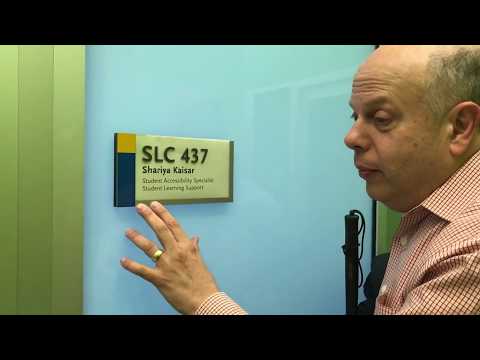
Signage.
This sign in print says,
"Student Accessibility Specialist Student Learning Support."
But in Braille all it says is, "SLC – Student Learning Centre – 437.
So this sign about accessibility support isn't accessible.
Washroom signage.
So I'm now standing in front of the opening to these two washrooms.
Of course, I don't know that there are two washrooms here.
If I reach out to my left, and I feel along the wall,
there is no Braille signage.
If I go to the right of the opening
and feel along the wall, there is no signage.
I have no idea what it is.
That's where I would have looked, if I looked at all.
I prefer if if there was a door, uh, here, with signage.
Now if I step in to the anteroom,
to my left is the hall to go to the men's washroom,
and to the right is the hall to go to the women's washroom.
But as a blind person, all I'm hearing is echo.
It sounds to me like it's just one big washroom.
There is Braille signage on the wall in front,
between the entrance to the men's washroom on the left
and the women's washroom on the right.
But I wouldn't know there is Braille signage here.
I'm not going to walk in here and flail my hands along a big wall
that's more than a couple of metres wide
to wonder if I'm gonna run into Braille signage.
Now because before shooting this video I was told there's a sign here,
I put my hand on the wall and I feel "male accessible washroom."
That's great, but I don't know that that's to my left,
or that there's a women's washroom to my right,
or that there may be more Braille signage to my right,
saying it's a women's washroom.
So I won't know from this Braille signage,
which I would probably would've never have found anyway,
that it's to the left that I have to go to go use the men's washroom.
So this is, this is signage which is functionally useless.
Entrance to Sam the Record Man.
Turning our attention to the outside of the building,
the first accessibility problem here
is the fact that entrance to the building is not at the ground level.
You've got to get from the ground level all the way to the second level.
In contrast, the building that used to be here for many years,
the Sam the Record Man store, had level access,
right in the front door, right at street level.
What's shown here now is the contrast of Sam the Record Man's old entrance,
where you could go in at street level to get right in the store,
and the new building.
And in the case of the new building,
there's a flight of stairs or a ramp to get up to the second floor to go in
if you're going into the Student Learning Centre.
There's also an elevator for getting from the street level
up to the main entrance.
There's a street-level entrance to go right in the building,
but that's a performance arts entrance.
That's only for people who are going in
to attend a theatre that's underneath this building.
If you want to get access
to the main doors to the Student Learning Centre,
and you're down at street level, you approach the steps,
There's no way to know that there are two other ways
to get up to the front door – a ramp or the elevator.
There's no directional signage to tell you about them,
and they're not readily apparent.
On the left are the steps.
On the right is the ramp, but it cuts through hangout steps
which obscures a sighted person's view of them.
Further to the right, beyond the ramp, is the elevator.
Exterior ramp.
Here's an outside ramp to get from the street level
to the building's front entrance, one floor up.
I try to make my way up the ramp.
Again, here, we're speeding up the video just briefly
to shorten the time to depict this.
It's not a straight ramp, nor a normal patterned switchback.
It's a zigzaggy ramp.
It is impossible for me to know the path I am to follow,
both because it's irregular,
and because there's no tactile wayfinding.
The first obstacle I encounter on my way up the ramp
is a leaning pillar,
a pillar that's not just straight up and down
like pillars should be,
it leans in to the right.
So as I'm walking up the ramp, my shoulder brushes up against it.
There should be no obstacles at any height in the path of travel.
The next obstacle is that the path, rather than going straight,
zigzags to the right and then the left as it's going through hangout steps.
Of course if there's anyone hanging out on the hangout steps,
they could well end up hanging out in my path of travel.
I encounter people, dogs, hanging out
where people are intended to be walking up and down a ramp.
I then reach a switchback in the ramp,
but where it takes place,
there's a landing for the stairs going up.
I get confused. Why are there stairs here?
Which way am I supposed to turn to continue on the ramp?
There's no way to know.
In the video, I get completely lost and off-track.
People come over to offer help to me, which is very kind,
but I say, "No thank you,"
'cause I'm trying to figure it out myself, if I can.
I now approach a switchback and a landing,
that to a sighted person watching this video,
might look like a normal switchback that shouldn't be confusing.
But it was for me because there's no wayfinding,
and I've had to come up a route that is so unpredictable,
and so confusing, and so failing to follow any traditional pattern,
that I have no idea which way I'm supposed to go this time.
Now, I'm beginning to proceed up the remaining part of the outside ramp.
Exterior stairs.
Starting at the base,
there are three sets of steps in front of me.
They are divided by two sets of handrails.
Our first problem is that if you take the left-hand most set of steps,
there's only a handrail on the right side, not on the left.
If I try to take the right-hand most set of steps,
there's only a handrail on the left, but none on the right.
There needs to be a handrail on both sides.
Making this worse, these steps,
like the steps in the main lobby, are angled steps.
But worse than the ones in the main lobby,
the only way to go from the ground level to the second level
is by walking angled to your right.
If I follow the railing,
it doesn't allow me to walk up the steps
with my feet going perpendicular to the steps.
I walk into a railing that's cutting across my path.
They do have colour contrasting
on the nosing of the steps, here, which is good.
Exterior elevator.
An alternative way to get up
from the street level to the front door of the building
is provided beyond the stairs and the ramp.
There is an exterior elevator, outside the main building.
It's good that they do provide an elevator,
but is in the furthest position away from Yonge Street.
There is no directional signage to let people know it's there.
The only sign that identifies it as an elevator
is a window decal inside the elevator lobby.
It has a low colour contrast, making it harder to see,
especially when on the day we were shooting this video,
there's a whiteboard sign behind it.
There is a power door operator outside,
but just above the button to open the door,
is one of those cards for waving a security card.
This would suggest to anyone
that this is only available by way of a security card.
And it's not explained anywhere outside the structure,
when or whether you can get access inside to use the elevator.
Standing outside, you'd have no idea whatsoever
that it's available to you.
If you look, there is a two way communication button also provided.
And it's on the hinge side of the door.
So if you're standing there using that, and somebody opens the door,
you are in the line of fire for the door to whack you.
Now we go inside the elevator lobby.
We look back at the door we just came through.
We see that there is a power operator to open the door.
That's great. But this time, it's on the hinge side.
It's not on the side of the door where we found it
when we were outside the building.
There isn't a consistent positioning of the power door operator.
That is a formula for confusion.
There's a sign that says that this elevator
will take you to the main level,
that's level one, that's where the main door is,
and levels two and three, where the sandbox is.
This lets us know that you can only go up to those levels if you have a card.
It tells you to use the main elevators, the ones inside the building,
to get access to levels two through eight,
although I can't access any of this helpful information
because none of it is available in raised letters or in Braille
for a person with vision loss.
Now let's look inside the elevator.
It's great that they have Braille on the elevator buttons,
and it's great that there's a voice on the elevator
to tell a person with vision loss or with some learning disabilities
that, by voice, it will tell you what floor you're on.
However, there is a problem.
Looking at the elevator buttons,
they have print next to the buttons, of course,
and Braille next to the buttons.
Well, that's great. And there's a voice in the elevator
that tells you audibly what floor you're on, and that's great,
but they've messed up their labelling for the street level floor.
The print button says G. [elevator beeps and says level G]
The voice says level G.
The Braille says main.
What the heck is main? Is it the main entrance to the building?
Is it the main floor of the building? Is it....
I'm confused.
Now, next to the elevator buttons there is a partial guide to each floor,
and there is a notation that the ground level is the street level.
But that doesn't tell me what main means.
It's good that there's Braille on the floor directory
to the left of the elevator buttons,
but, unfortunately, they didn't check
to make sure that the vendor that was supplying their Braille
actually makes Braille that's easy to read.
This Braille isn't.
The dots are too sharp, they're squished too close together,
making it harder to read.
Before deploying Braille signage or even buying any,
it's really important to check with end users
to make sure that it's properly legible.
We now arrive in the elevator to what it refers to as level one,
which is the level of the main entrance of the building,
up the external steps or up the ramp.
As we pan to the left,
we see another power operator for an exterior door
to go outside at level one.
You don't just go right into the main building.
You have to go outside,
you have to turn right, you have to go up a short ramp,
you've got to turn right again to get to the main door.
There is no directional wayfinding to assist someone in finding this route.
Angled pillar.
Turning out attention back to the exterior elevator we looked at earlier,
let's look at what's just outside the elevator lobby entrance door.
Once you If I use this elevator to come down to the street level,
as I walk outside the elevator lobby door,
I walk straight into another angled pillar –
not a straight up-and-down pillar.
This pillar is even more angled than the last one,
so I didn't just brush up against it.
I hit my head on it, on the right side, uh, near my ear.
Conclusion.
Thank you for joining us on our tour of accessibility issues
at the new Student Learning Centre at Ryerson University in Toronto.
Watch how these problems come together.
The main lobby has that angled staircase,
inaccessible hangout steps,
and both an information desk and an electronic kiosk,
each lacking basic accessibility features.
The sixth floor beach area has angled stairs
that follow a confusing route, a maze-like ramp with no railings,
and hangout steps.
At the building's front, instead of a ground level main entrance,
are angled stairs following a confusing route,
a ramp that follows a confusing route
with inaccessible hangout steps luring people to hang out on the ramp,
an exterior elevator that many won't know about
or won't think they can use,
and angled pillars in the path of travel.
It's troubling that this building won architectural awards.
Here's a webpage announcing that it received
the Canadian Architect 2011 Award of Excellence
from the Canadian Architect magazine, selected by a jury of architects.
Accessibility deserves greater priority.
It's commendable that Ryerson wanted to include good accessibility features.
It's deeply troubling that so many accessibility problems are the result.
What can we do about it?
Well, first, we encourage you to follow the AODA Alliance
and get involved in our activities,
advocating so that this never happens again.
Visit our website at www.aodaalliance.org.
Sign up for our emails.
Send an email to us, and all you have to say is "sign me up."
Our email address is aodafeedback@gmail.com.
Follow us on Twitter, @aodaalliance.
We also encourage you to take pictures or videos
of accessibility barriers and tweet them.
Use words to describe it, so that blind people like me
can know what's in the picture.
If you use Twitter, we encourage you to include the hashtag, #AODAfail.
That will help others, who are active on accessibility,
to see what barriers you've been able to identify.
We also encourage you to tweet AODA wins,
so people can see where accessibility is done right.
Finally, we urge you to press the Ontario government
to ensure that strong and effective accessibility standards are enacted
to ensure that these kind of accessibility problems never recur.
It's important for everyone to understand
that those who design buildings and those who build buildings
will be held to strong accessibility account.
Their obligations are not just to comply
with our weak Building Code's accessibility requirements,
or the very limited public spaces accessibility requirements
already in force under the Accessibility for Ontarians with Disabilities Act.
The prevailing law they must obey is the Ontario Human Rights Code.
It guarantees equality to all people with disabilities.
And either creating new barriers against people with disabilities,
or leaving existing ones in place,
directly fly in the face of the guarantees of equality
to people with disabilities in the Ontario Human Rights Code.
Thanks for watching.
If you want to watch a shorter version of this video,
go to YouTube, and search on "Ryerson,"
and "accessibility," and "short version."


Không có nhận xét nào:
Đăng nhận xét